Check out the conversation on Apple, Spotify, and YouTube.
Brought to you by
Fingerprint - Identify good and bad visitors with industry-leading accuracy
Ariso - Ship AI agents and features faster, with fewer regressions
Customer.io - Send smarter messages using your product data
Amplitude - The market leader in product analytics
Product Faculty - Get $150 off their #1 AI PM Certification via code AAKASH150
Today’s Episode
On February 28, Pieter Levels posted that for the first time in his life, he thought he’d outrun his to-do list. With Claude Code doing the building, the bug board his users post to was empty.
I’d say this is about 10x my normal output, he wrote about the week’s shipped list. Over 1 million people viewed it. His last line:
The real bottleneck is becoming myself and my creativity, not how fast I can ship.
John Cutler ran into the other side of it. He wrote that CEOs now claim their teams are 100x more effective. He asked one, who runs a collaboration tool, whether there was 100x more demand for their product. The answer: “Crickets.”
That’s where most product teams are right now.
Output is up, and the open question is whether any of it made a difference. Or as today’s guest put it on the show: When features get cheap, not having chosen the right feature, funnily enough, gets more expensive.
So today I brought in the strategy guy, Tim Herbig (10+ years as a PM and Head of Product, now coach to product teams), to spill
How do you tell a good strategy from a list of priorities
What role should AI play in your product strategy
And which metrics prove it’s working
He walks through all of it on a live board, with one made-up company that stands in for many of his clients.
Two FREE Resources!
The podcast is, of course, totally free (as is the newsletter deep dive below). I have two more resources for you, as well:
A Free Webinar on the Job Search
Want more interview callbacks without sending more job applications? Join me for a free live class this Friday, October 16, at 9:30 AM PT / 12:30 PM ET:
A Free Conference to Up-skill in AI
I’m giving a talk on the “Future of the Full-Stack Builder” and moderating a panel on the future of product in two weeks, Thursday, October 29, at 9AM PT / 12PM ET:
Everything I do is for you. I hope these free resources help you in your career.
🎁 And Contest to Win a Free Book!
I’m also giving away 5 copies of Tim’s book, Real Progress. It’s just 3 steps:
DM me a screenshot of both on LinkedIn
The first 5 people get a FREE copy!
Newsletter Deep Dive
Now… to our main event. As always, I’ve written up the podcast as well. That’s how much I value being in your inbox. Here’s what we’ll cover:
What product strategy is actually for, and where AI fits
How to test whether you made the right choice
How to choose differentiators that survive AI
How to know if your strategy worked
1. What product strategy is actually for, and where AI fits
A few years ago, the limiting factor for most PMs was time. Building took a long time, so you had to prioritize ruthlessly. Today, even established companies get stuff out the door much faster.
But you still have to get people to use what you ship. Tim says many of his clients told him a year ago that feature adoption was already a problem.
So sooner or later, every team amping up its output has to ask: did any of it make a difference?
Our mutual friend Ravi Mehta (former CPO at Tinder) says difficulty prioritizing is often a strategy issue, not an execution issue.
So you need to start there.
Treat your strategy like a product.
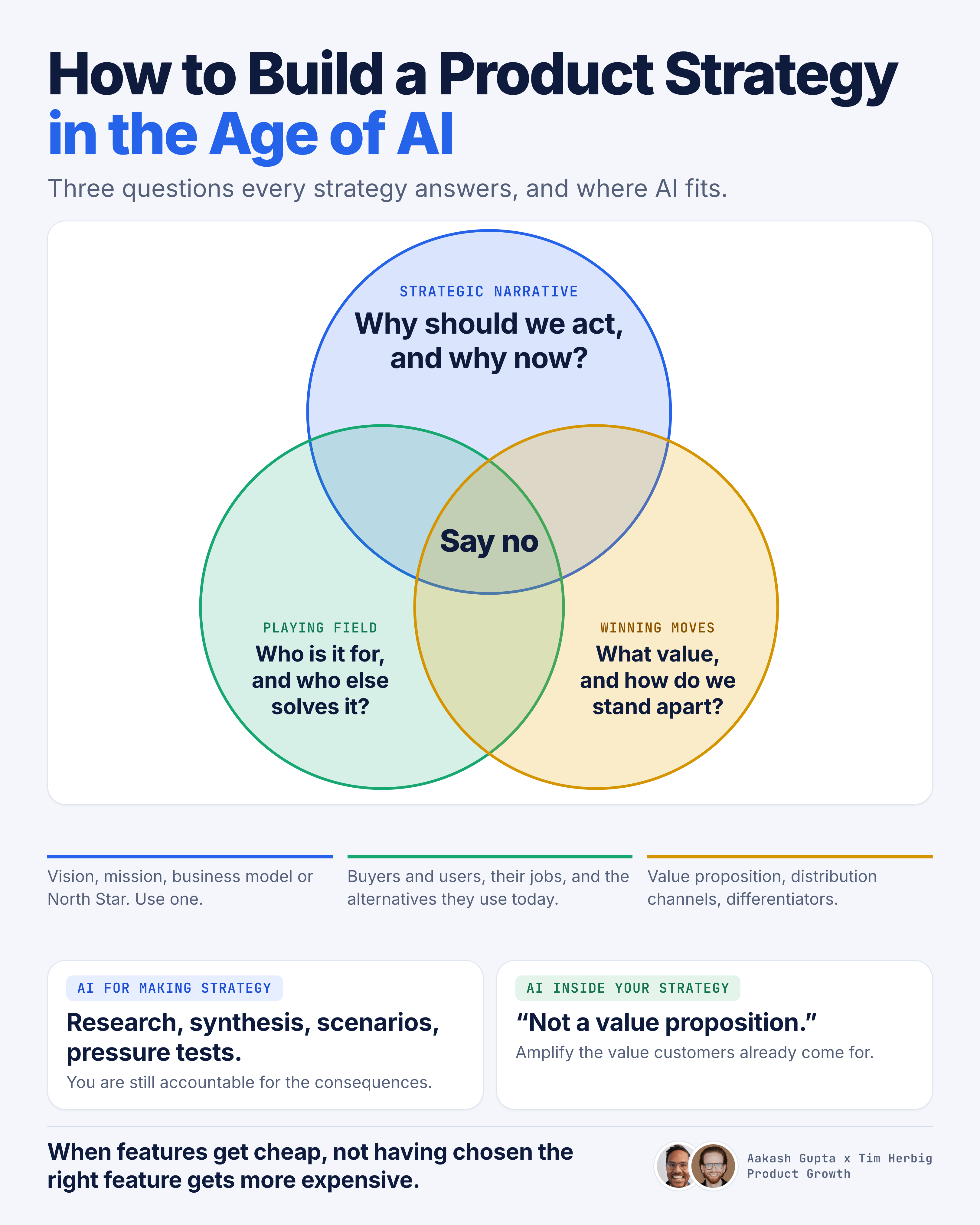
Who is it for, and how would you know it worked? It’s for your teams and stakeholders. And it works if it helps them intentionally say yes or no to opportunities over a set horizon, say 6 to 18 months. You know it’s working if most of your team’s energy goes to work connected to the strategy.
As a product leader, I was once handed a strategy with 14 priorities. So what makes a strategy able to say no?
Strategic narrative
Why should we act, and why now?
Playing field
Who are we solving problems for, which problems, and what do they use today instead of us?
Winning moves
What value do we provide, and how will we stand apart?
Your answers have to be opinionated enough to enforce a no.
Tim’s view of canvases and templates: they’re windows into the actual work of strategy. The fundamental questions don’t change. Answer them first, then assemble whatever shape your boss wants.
Where AI fits (and where it doesn’t)
It would be stupid if we didn’t use AI as a tool for making strategy. Researching markets and competitors; synthesizing customer evidence; generating and comparing scenarios; pressure-testing your bets. But you’re still accountable for the consequences.
Treating AI as the value proposition is wrong. Almost no technology in history has been one on its own. AI is a resource you use to amplify the core value customers already come to you for.
Everyone has access to the same frontier models, but you can’t compete on that alone. I pushed back with 2 counterexamples. Pieter Levels’ Photo AI, which does $83K a month in revenue as a one-person company. And ChatPRD, which Claire Vo built while she was a CPO. Isn’t AI the whole product there?
Look at what’s layered on top. People root for Levels because of his personal brand, which keeps him out of a head-to-head with the big companies. Tim’s bet is that people pick ChatPRD for Claire’s product judgment built into it. That matches what I wrote in my AI product strategy guide in March.
2. How to test whether you made the right choice
A favorite pressure test comes from Roger Martin, who I had on the show for a strategy masterclass. Once you see it, you can’t look at strategy the same way.
The best strategic choice is one where you can say the opposite, and it’s not stupid.
If the opposite is stupid on its face, you haven’t made a choice.
Tim’s example: “make salespeople more efficient.” The opposite is slower salespeople, which is stupid, so that isn’t a choice. “Make salespeople more efficient by being in person with clients” passes, because virtual contact is a real alternative. One of Tim’s clients calls this the stupidity flip.
For example, sellers and dealers want qualified buyers who buy fast. Buyers arrive from Google and AI search. Many are first-timers who don’t trust a car they haven’t seen. Fair Mile (a hypothetical used-car marketplace) steps in to handle inspections and build trust.
Its default strategy is to paste AI everywhere. That’s an all-yes strategy that says no to capital, margin, and quality.
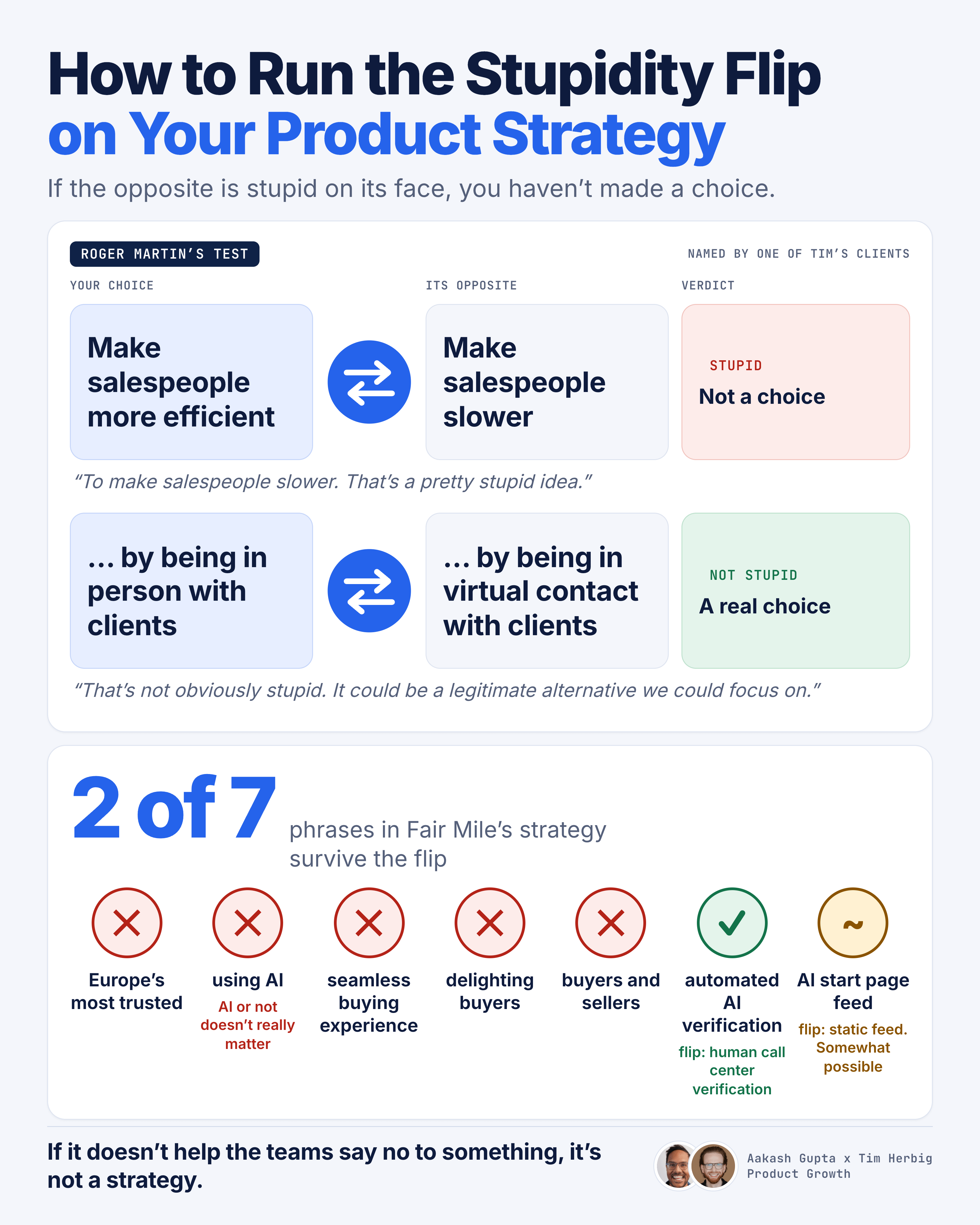
Of the seven things Tim flips, only 2 are real choices. And they’re the operational ones, where the company picks a mechanism (human call-center verification vs. automated, a static start page vs. an AI-personalized one). The headline phrases fail because no company would argue the opposite.
When I was at Apollo, the strategy from our CEO was to only focus on paid users. But as a product leader, I couldn’t just ignore free users. So how myopic should a strategy be?
First, a strategy doesn’t have to cover everything you do. Focusing on paid users doesn’t mean turning the product off for free ones.
Second, the choice has to fit the narrative. Why paid users? If the narrative is to grow revenue by improving retention for paid users, then a push to acquire more free users is a contradiction.
That was exactly our reasoning at Apollo. Retention was the biggest lever.
Strategy isn’t a top-down thing. You can start anywhere. Someone hands you a segment, and you ask why. Someone hands you a differentiator, and you ask who it’s for. The answers don’t have to be right, because no one knows what’s right anyway. They have to reinforce each other.
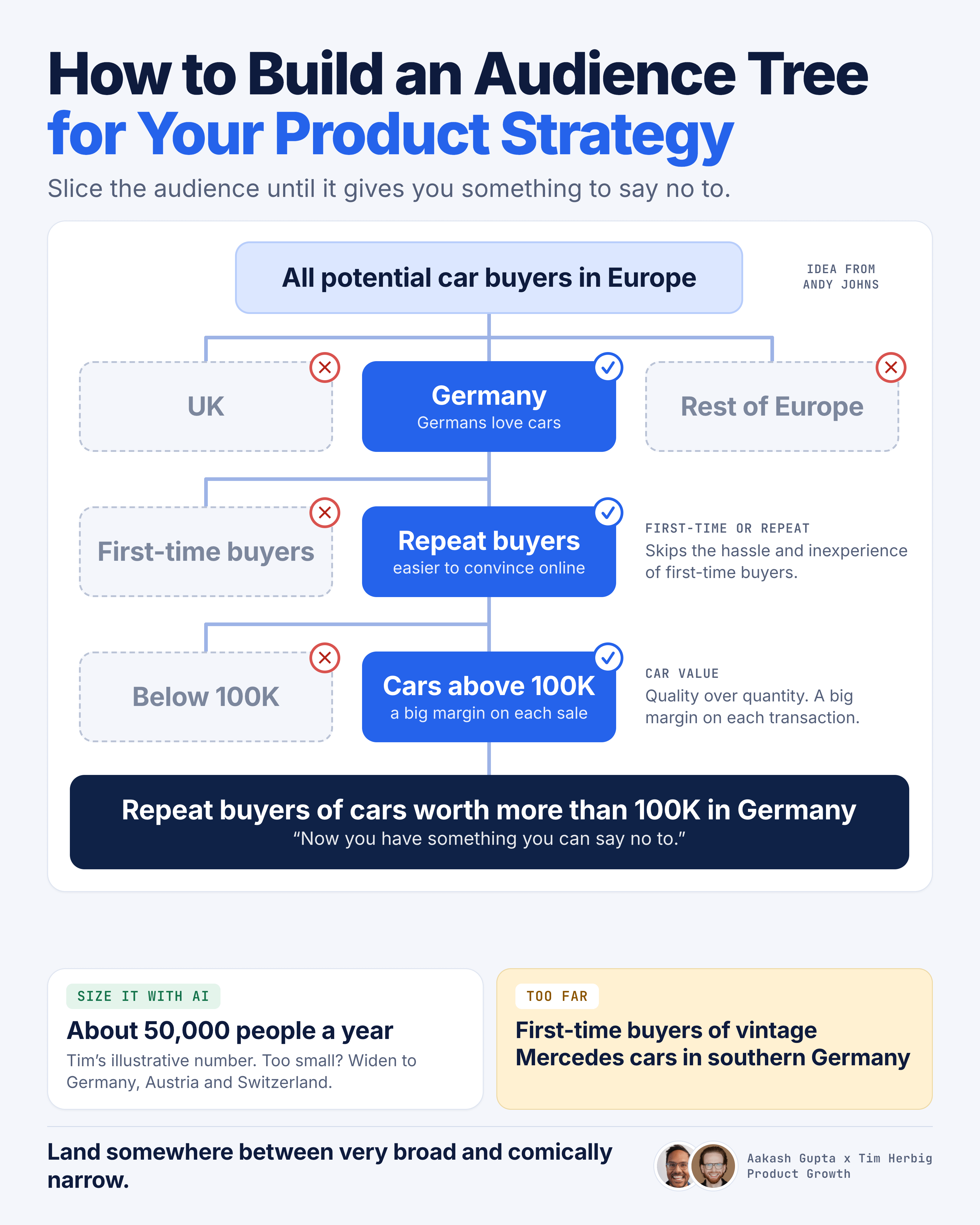
Once the audience is set, everything downstream narrows. Tim borrows the audience tree from Andy Johns, a former growth leader at Facebook, who said your target audience should be comically narrow. Tim’s guardrail: land somewhere between very broad and comically narrow.
The audience tree works like this. Start with the broadest audience and a comically narrow one, then list the ways you could slice it: region, income, car value, first-time or repeat buyer. For Fair Mile, Tim lands on repeat buyers of cars worth more than 100K in Germany. Germans love cars and often buy new ones. Repeat buyers might be easier to convince to buy online. And above 100K, every transaction carries a big margin.
This is where AI helps. Ask it how many car owners there are in Germany, how often they buy, what they pay, and how many cars competitors list above and below 100K. Tim’s illustrative answer was about 50,000 people you could reach every year. If the number is too small to fund the company, widen it. Germany becomes Germany, Austria and Switzerland.
3. How to choose differentiators that survive AI
Tim calls differentiation the trickiest component, and the one AI changed the most. He doesn’t invent a new framework for it. He goes back to Hamilton Helmer’s 7 Powers, the classic list of sources of lasting advantage.
For each power, he asks
What does it do?
Can we actually execute it?
Does it help us differentiate from our competition?
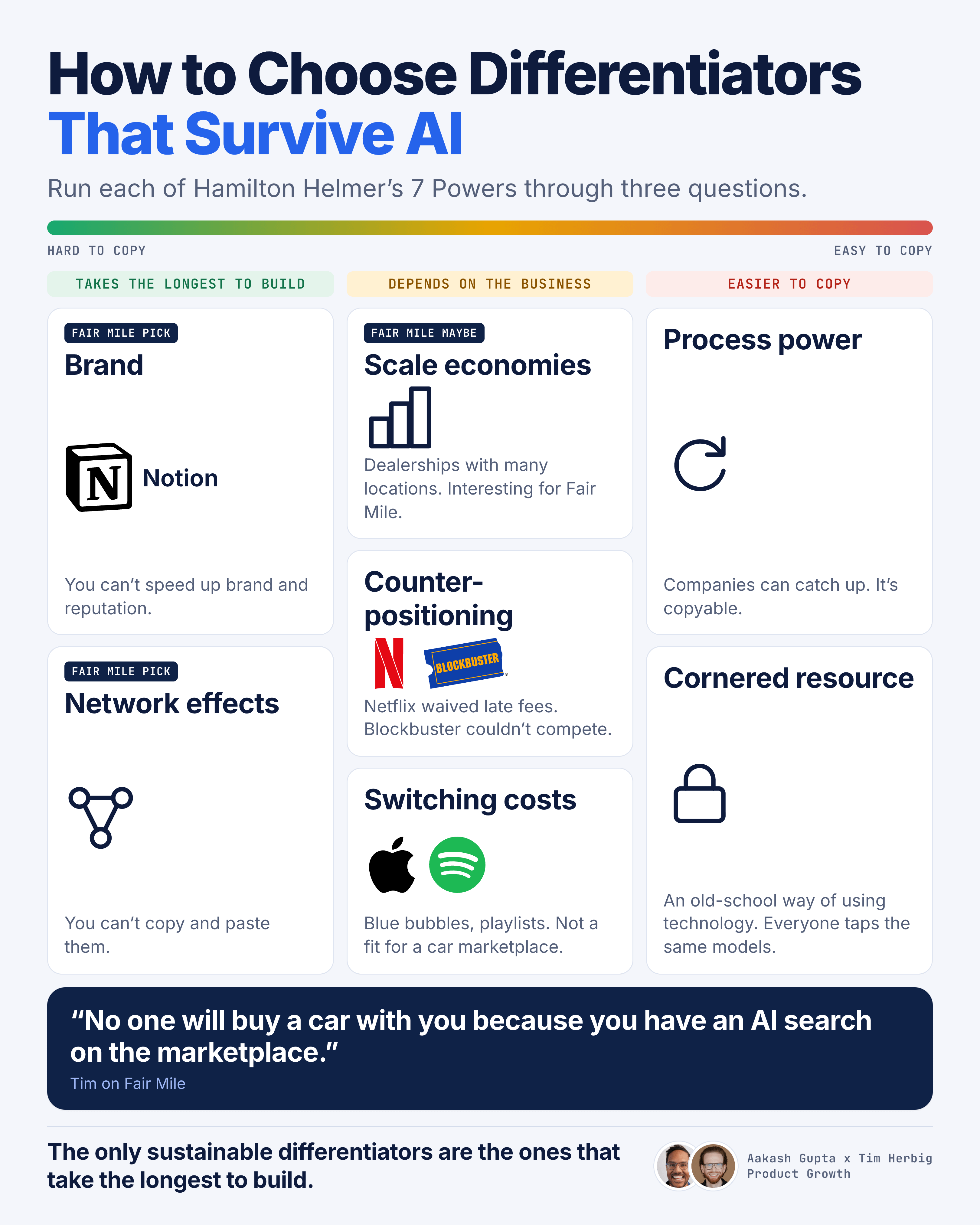
Notice the pattern in what survives. The durable powers are the ones that take the longest to build. You can’t speed up a brand or a reputation. You can destroy one incredibly quickly.
Counter-positioning is worth a second look, because the classic example is so clean. In 2000, Blockbuster collected nearly $800 million in late fees, 16% of its revenue. Netflix offered subscriptions with no late fees. Blockbuster couldn’t follow without breaking its own business model.
For Fair Mile, Tim picks brand and network effects, with dealership scale as a maybe. Switching costs don’t fit a car marketplace. And he would skip a fancy AI search: “No one will buy a car with you because you have an AI search on the marketplace.”
So if there’s an order: audience first, then powers?
The truth is, you can start anywhere. Joe from marketing walks in and says, We now differentiate on price. Fine, follow the link. Is our audience price sensitive? Why do customers pick competitors today?
And if the answer is price, get out of that market. You can’t win on price. Tim’s only exceptions are companies like the big AI labs, which can subsidize price for a while. You don’t have that luxury.
4. How to know if your strategy worked
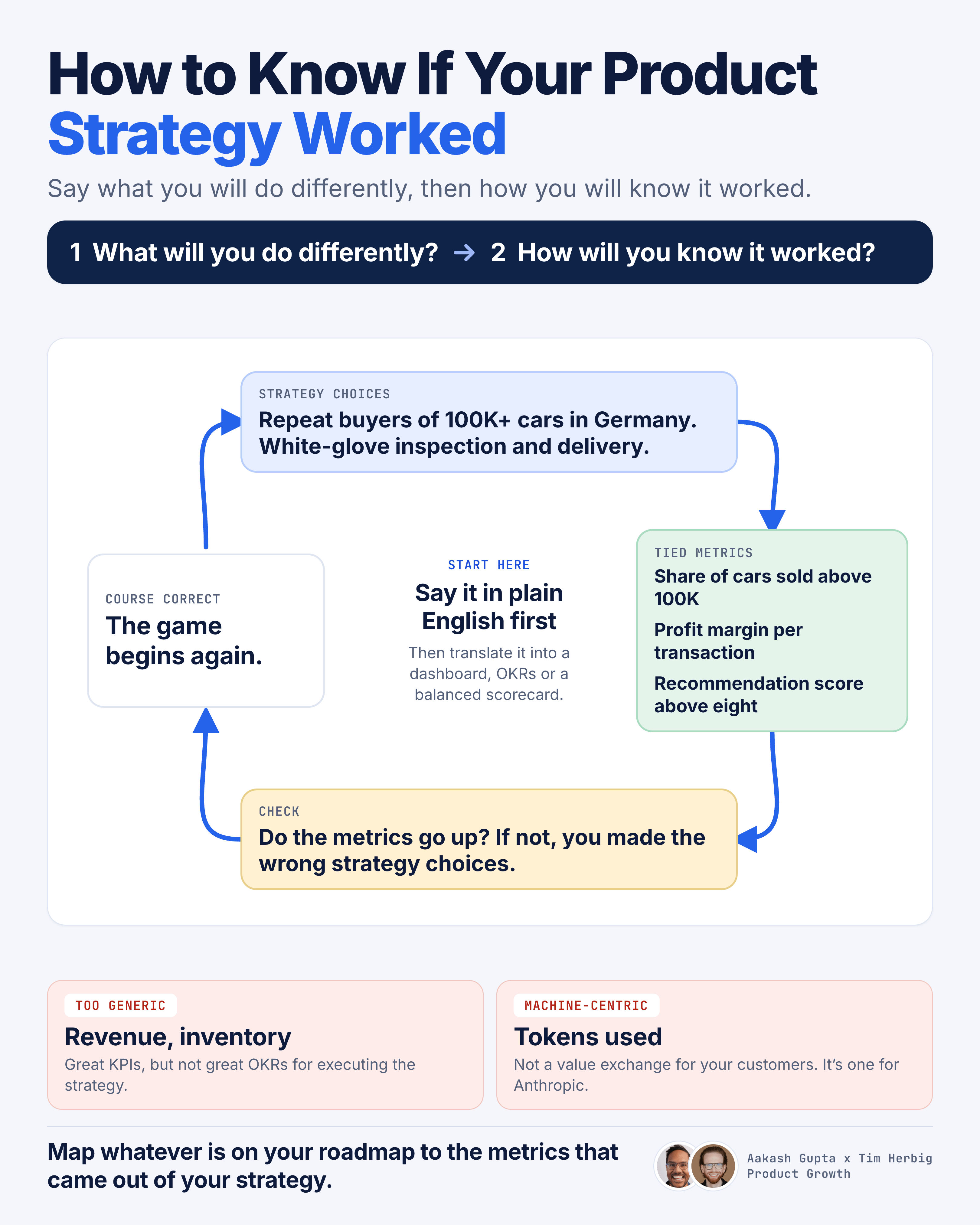
When teams hear metrics, they jump straight to the framework. Instead, answer 2 questions in plain English first:
What will you do differently?
How will you know it worked?
This applies to B2C, B2B, and internal teams alike. AI teams usually reach for metrics like tokens used or output. Tim’s line: tokens used is not a value exchange for your customers. It’s a value exchange for Anthropic.
So ask whose behavior should change, and by how much. If the goal is 20x more AI feature output next quarter, ask what changes for whom as a result. Do you want your team more AI-fluent? Or customers solving their problems faster? Make that the goal.
The same goes for the North Star metric. Teams think it is EBITDA, but it’s not. Tim credits Sean Ellis with the concept. Ellis defined it as the metric that represents the value customers experience from your product. When it rises, business metrics should follow. The business metric itself is something else.
If you’re burning tokens to ship faster but still need months to see customer behavior change, what exactly is the point of that?
You can also use Ravi’s product strategy stack. Think of each level as a funnel. For every choice from the level above, ask whether it already lets me say no.
Before setting your strategy, ask what the company is already incredibly good at, and how your area can build on it. Personio calls these evergreen benefits.
If the company has mastered a distribution channel or has integrations in place, don’t reinvent them at the feature level.
Only then connect the roadmap. Every roadmap item should map to one of your strategy’s metrics.
Where to find Tim Herbig
And that’s all for today. Talk to you soon :)
P.S. You can get a year of the paid plan’s of my favorite AI tools with an annual membership: bundle.aakashg.com.