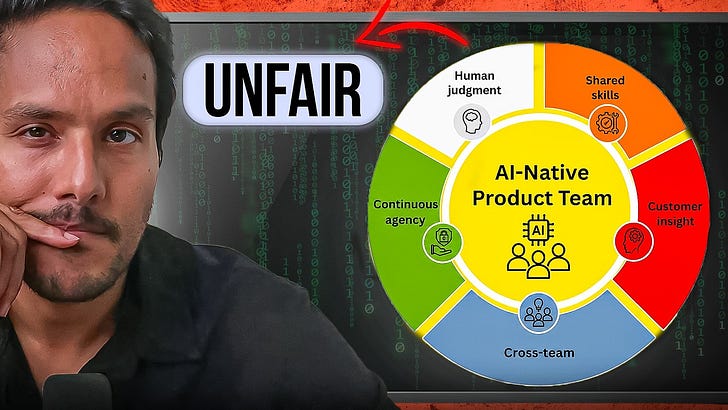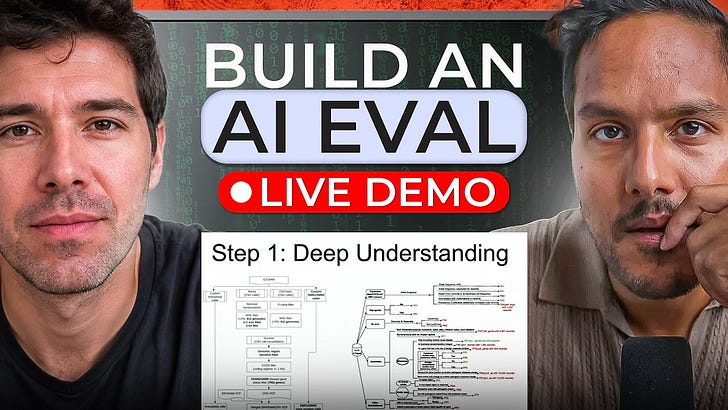
Check out the conversation on Apple, Spotify, and YouTube.
Brought to you by
Arize - Ship AI agents and features faster with fewer regressions.
Get a full year of Arize’s paid plan, along with 8 other AI tools, at bundle.aakashg.com.
Today’s episode
When Zapier published its AI fluency rubric, it went massively viral:


Tons of companies are following in their footsteps, explicitly adding AI fluency as one of the areas they evaluate their employees (and PMs) on.
So how do you get the transformative rating?
That’s today’s episode with Wade himself, the CEO and founder of Zapier. I present him 3 PM work products, and he grades them live:
Newsletter Version
Thank you for having me in your inbox! I also put together this newsletter guide to AI fluency for PMs:
The history of AI fluency
What capable, adoptive, and transformative look like
Why judgment still beats AI usage in the end
How to build your personal agent stack
Roadmap to a Transformative rating
1. The history of AI fluency
AI fluency is only about three years old. Looking back at the history is helpful.
March 2023
On March 14, 2023 GPT-4 launched and the world changed. Remember, GPT-3 really first came out in May 2020. GPT-4 was a nearly 3-year wait. And it proved to be worth it.
GPT-4 was a huge leap that really proved that AI agents could be useful at work. Zapier themselves declared a company-wide code red and ran a week-long hackathon.
Weekly AI use went from about 10% of employees to about 50% in one week. By March 2026, Zapier put adoption at 100%.
April 2025
On April 7, 2025, Tobi Lütke posted Shopify's internal AI memo on X himself.

It had three main points:
The expectation is you reflexively reach for AI.
You have to show why AI couldn’t do the job before asking for headcount.
AI use will explicitly go into your performance reviews.
The memo became a genre within months.
At Microsoft, a senior engineering leader told her org that using AI is no longer optional, and that managers should factor it into evaluations.
Meta made AI-driven impact a core expectation in performance reviews starting in 2026.
Duolingo published a version of the same thing.
May 2025
Zapier had a different take. Instead of a memo, they released v1 of their AI Fluency rubric.
It went massively viral.
March 2026
But V1 had a problem, in Wade’s words:
“V1 only screened for usage. The floor is constantly moving with AI.”
So on March 31, 2026, Zapier published v2, and that’s what we’ll focus on:
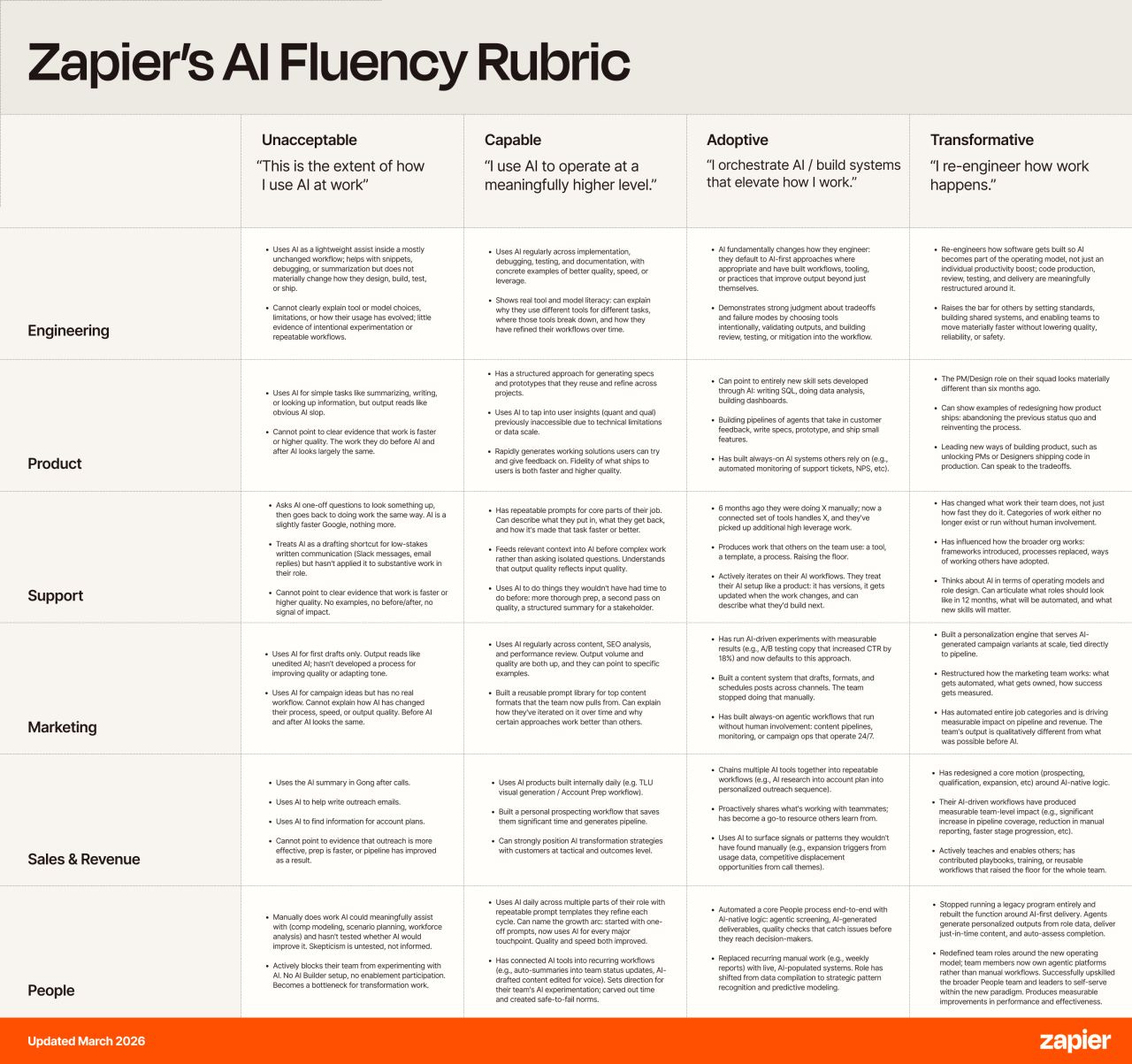
V2 grades people on mindset, strategy, and building. It also added a new dimension: accountability. The more capable AI gets, the more damage low-accountability use can do.
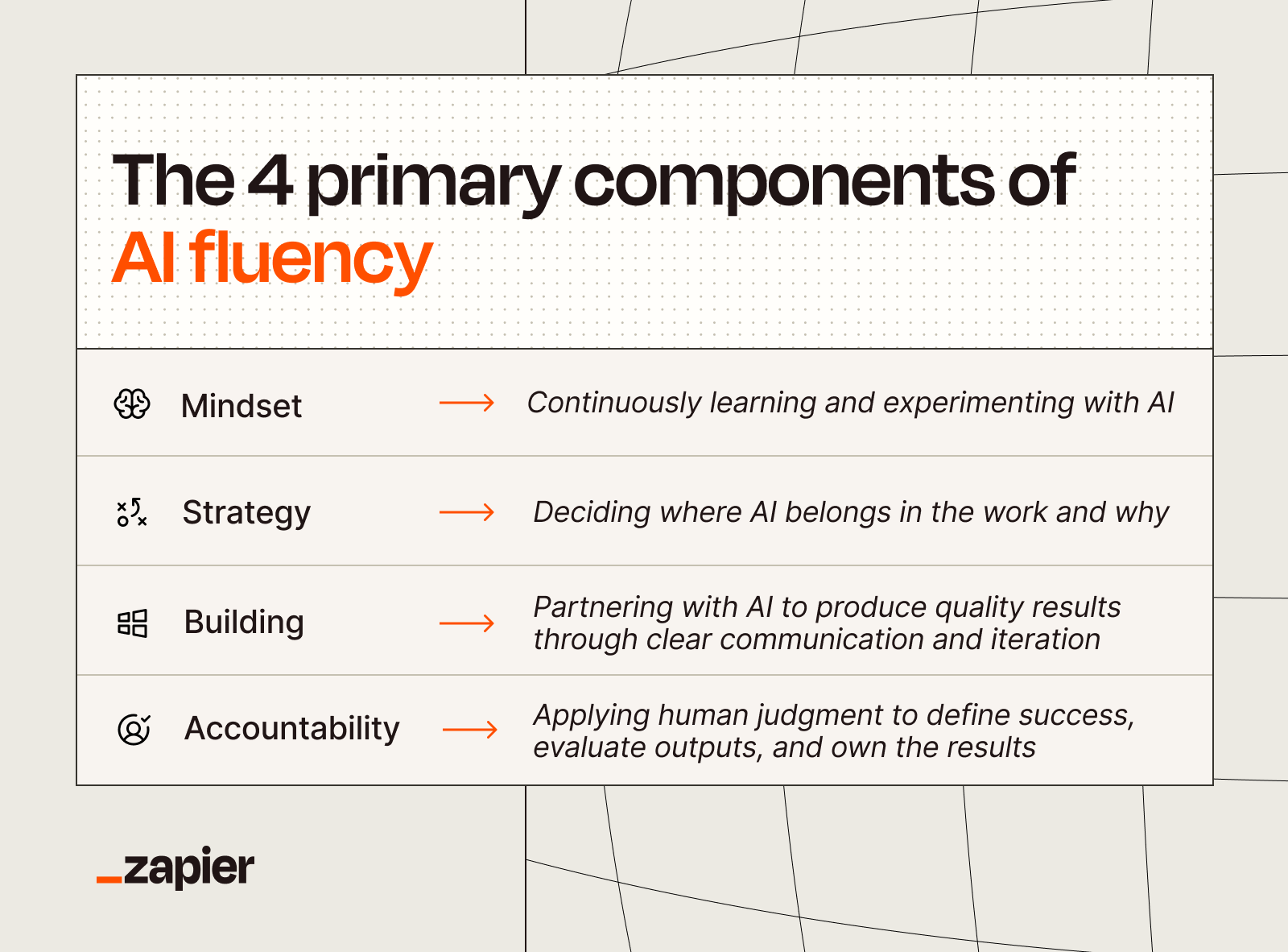
As Wade said:
With AI, you can delegate the work, but not the accountability.
April 2026
Then, the memos began to crack.
Duolingo dropped AI usage as a formal review metric. Their CEO’s explanation:
I’m not going to force you to do that.
So by this summer, companies had tried two approaches. Mandate usage, or define what good looks like.
Zapier’s version is the one that seems to be lasting.
2. What capable, adoptive, and transformative look like
I did the work for this episode. I built 3 sets of artifacts and had Wade grade them live (no collusion).
They mapped to the three rating levels.
What Capable Looks Like
Capable for a PM is a ChatGPT assisted PRD in a pretty good format:
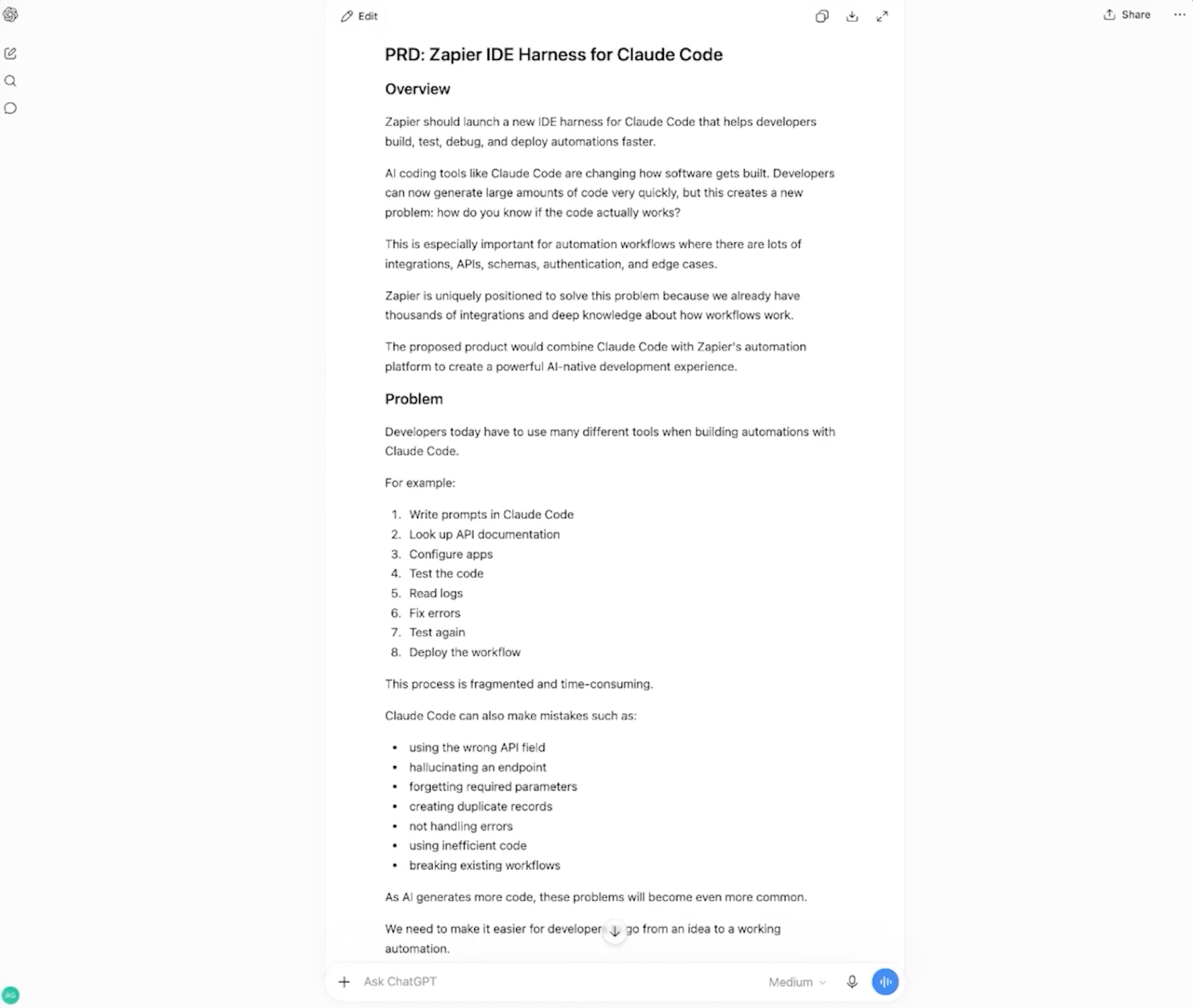
He pointed out it missed two things:
A prototype: Now that it’s so easy with AI, he would expect one.
Clear evidence: Where did customers ask for this? Gong calls, Zendesk tickets, Reddit threads, posts on X. AI makes sifting through that mountain of data fast, so it should be included.
Won’t you look at that! A CEO bringing up two of the key skills I’ve been banging the drum about by himself. The old PRD is dead.
Finally, as he said:
If there are things I know that you don’t know, that’s probably not a great signal.
So that’s a ‘Capable’ Rating. Now let’s look at ‘Adoptive.’
What Adoptive Looks Like
Here, I presented him a working prototype alongside a PRD that cited evidence. It was generated with my PM Operating System:
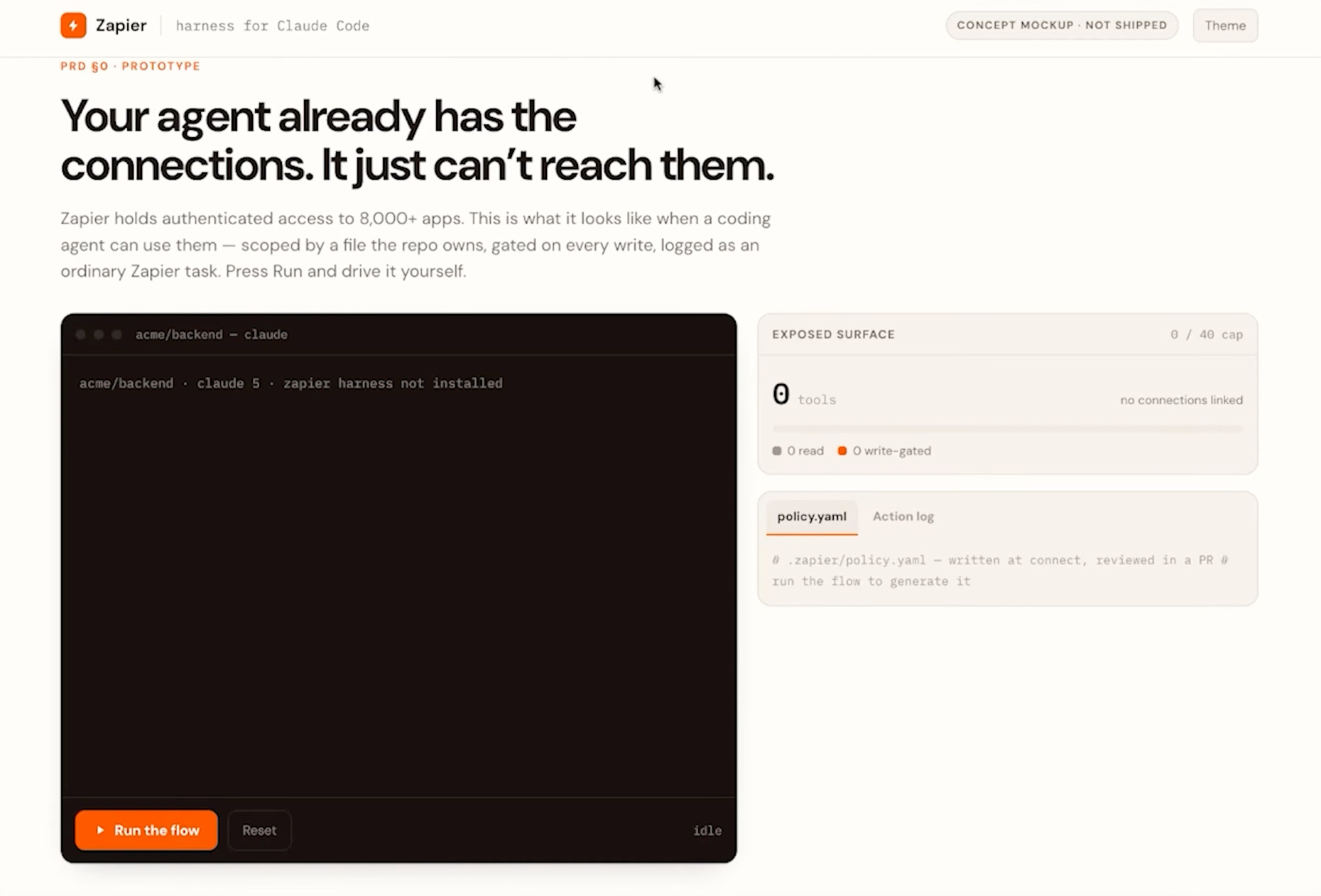
I managed to predict both his notes before the podcast!
What Transformative Looks Like
For the final rating, I showed Wade this:
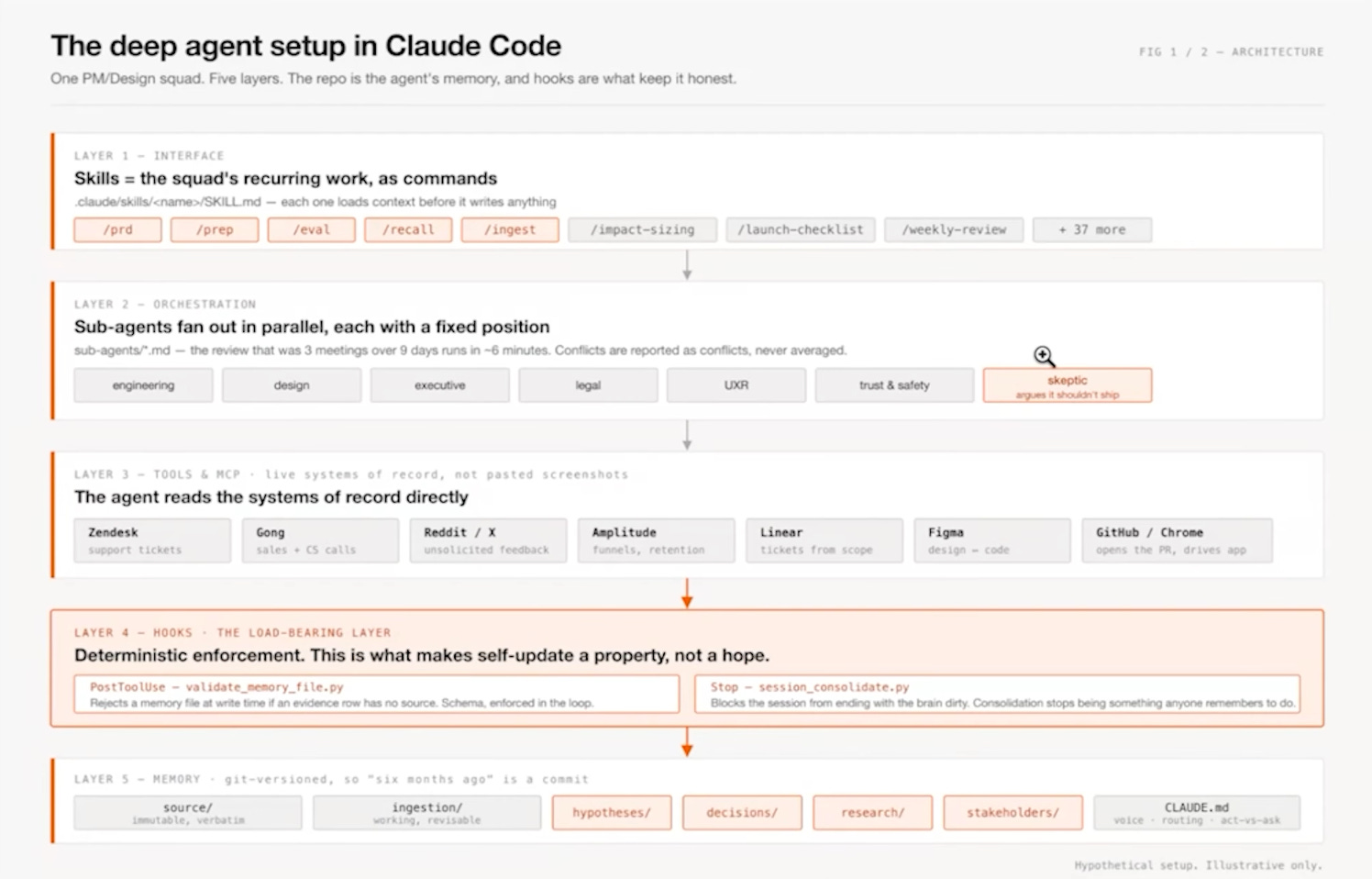
It’s a full operating model for a product team where:
Skills hold the team’s recurring work.
Subagents review in parallel, including a skeptic that argues nothing should ship.
The agent reads Zendesk, Gong, Amplitude and Linear directly.
Everything the team learns lands in a git-versioned memory.
And on top of all that is the auto-build cycle:
It clusters raw customer signals, tags each as an observation, interpretation, or hypothesis, and flags anything contradicting a past bet. The PM decides what to promote. Then an auto-build chain produces a PRD, a review panel, a prototype, evals, and draft code, with a second human gate before merge.
Wade called it transformative:
This is not how product and software was built three years ago. Not even close.
3. Why judgment still beats AI usage
Dan Hockenmaier has this wonderful graphic, and we all should remember it:
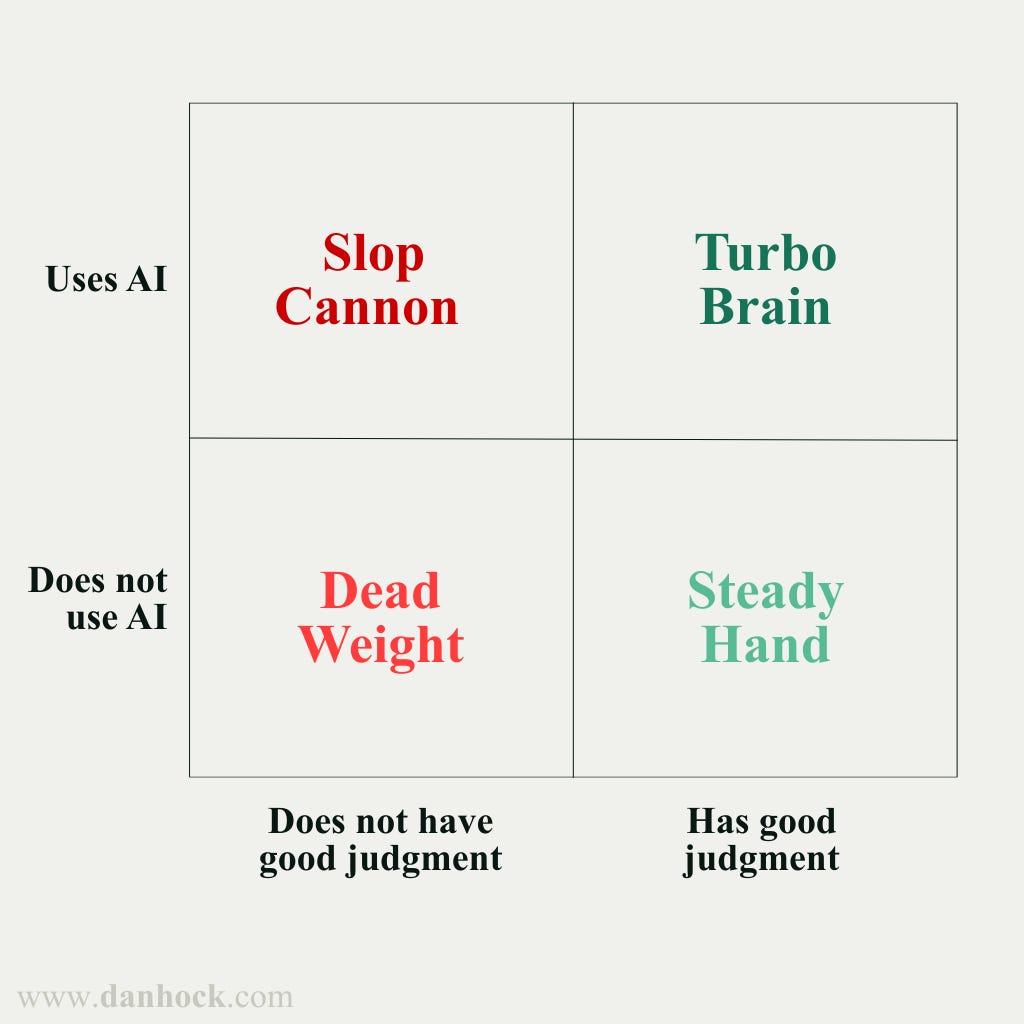
We want to use AI with good judgment, so we seem like a Turbo Brain.
You don’t want to be labelled a Slop Cannon. That’s a good route to diminish your reputation with stakeholders and lose influence over time.
Say how much effort went in
The worst version is passing slop off as finished work. As Wade said:
“Now you’re making me do the task.”
I see this on my own team. Someone sends me a doc they didn’t filter, and what they’re really asking is “is this good?” That’s handing the judgment job up to me.
At Zapier, people say upfront how much effort went in. Wade will write something like “I’ve used AI to draft this and done a quick skim,” or the opposite, “I stand by every statement.”
Speed is fine. Just label it.
4. How to build your personal agent stack
Wade had a massively viral tweet that Zapier now has “more AI agents than employees.”
So I had to ask him about it. He showed off his “robot staff.” You can copy it. It’s the basic scaffolding you need to get capable or adoptive:
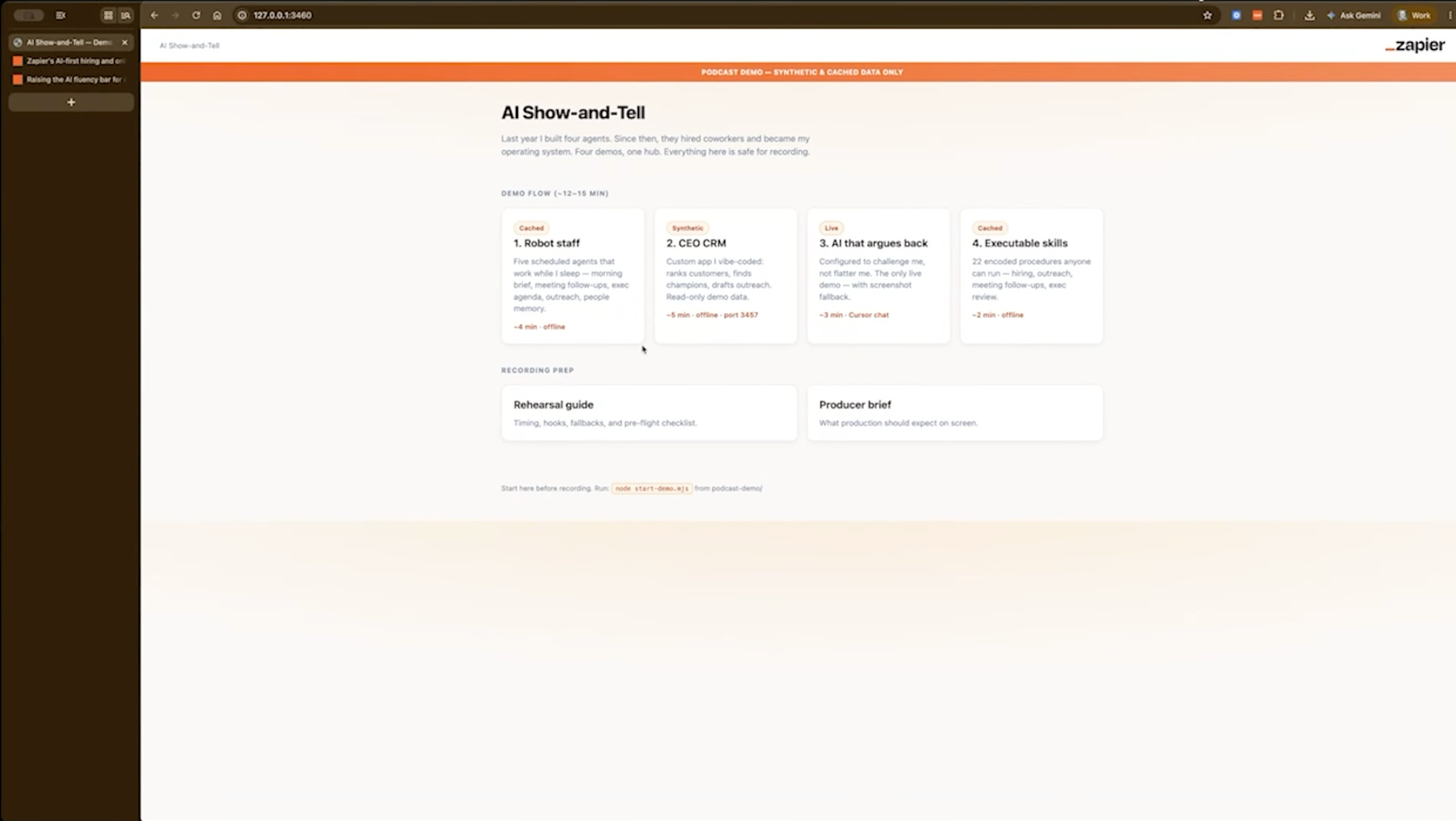
Agent 1 - The morning brief
At 6am, an automation pulls his calendar and to-do list and posts a brief to Slack. It’s the agent he tells everyone to build first, because connecting tools for the first time is easy here.
Agent 2 - The scribe
This is his favorite. At 5pm it loops over unanswered email, messages saved for later, and every meeting transcript from the day. It surfaces what he owes people and drafts the follow-ups.
Here’s a starter prompt for your own version.
Every weekday at 5pm, review today’s meeting transcripts, unanswered
emails, and messages I saved for later.
1. List every commitment I made to someone, with who and by when.
2. Draft a reply or follow-up for each one I can close today.
3. Flag anything that needs a decision from me, with one line of context.
4. Skip anything already handled.
Put drafts in my email drafts folder. Never send anything.
Agent 3 - The agenda setter
Wade’s exec and board agendas are now mostly generated by an agent that reads his week of meetings, Slack, email, AI chat sessions and metrics. He approves or rejects each item. If a conversion rate dropped, the agent puts it on the agenda whether or not anyone wanted to raise it.
Agent 4 - The CEO CRM
Every Saturday night, an agent scans Zapier’s enterprise accounts for upcoming renewals and usage swings. By Sunday morning, 10 to 20 draft emails are sitting in his inbox, each with a reason to reach out this week.
How do you build these?
You can just point Cursor at this article with the Zapier MCP.
Wade doesn’t write the code himself. He describes the automations to Cursor and deploys the result to Zapier.
5. Roadmap to a Transformative rating
First, ask, do I really want a transformative rating?
You see it’s not that 20-30% of the team should have a transformative rating. Wade says just like 1 PM on a team of 40 PMs should get it:
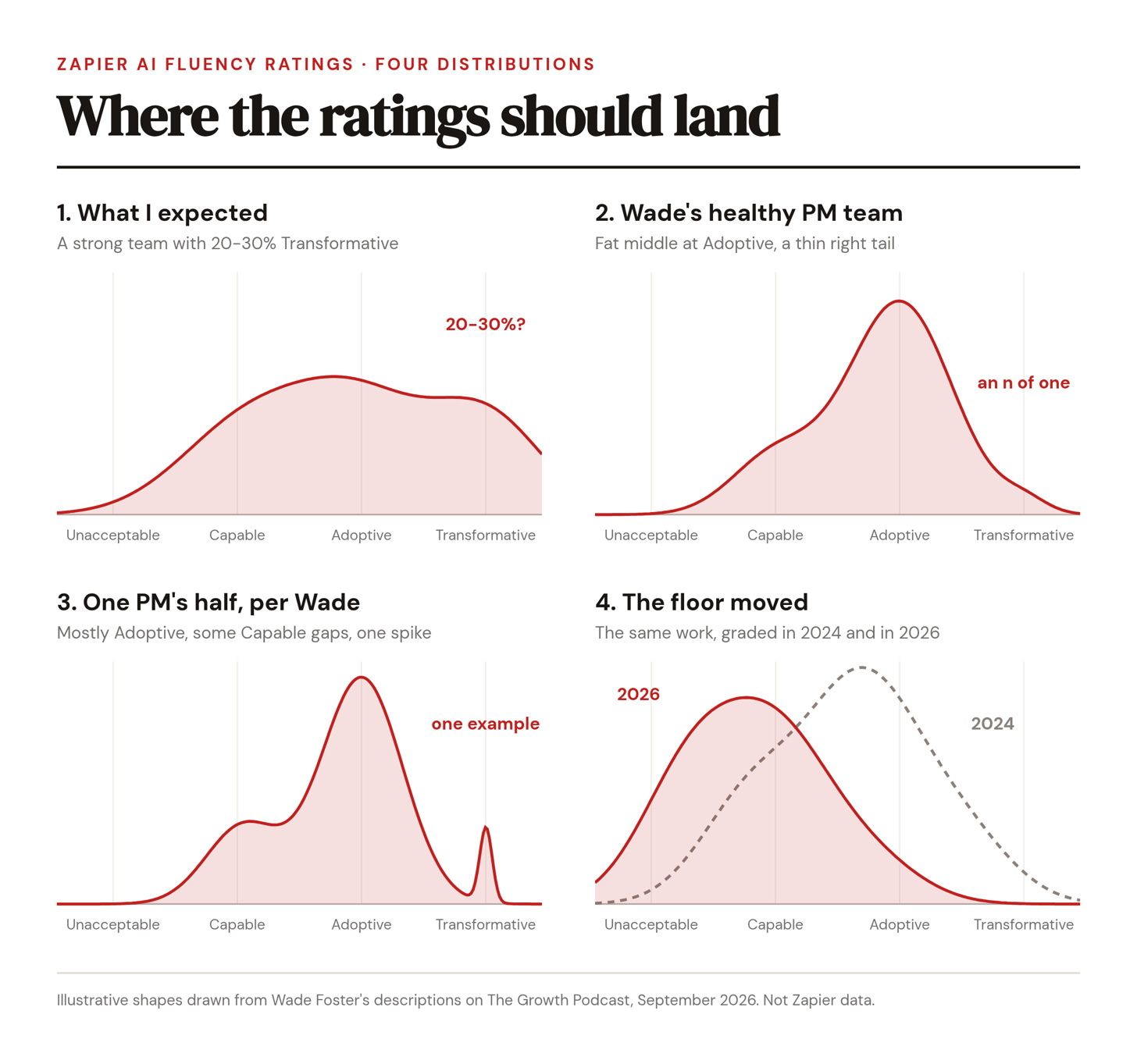
That’s because the floor moved. What was transformative in 2024 is just adoptive in 2026.
On top of that, he said being Transformative all the time is a warning sign. It usually means you’re tweaking your systems instead of shipping. As Wade put it,
“If you are, you’re not actually getting work done.”
I asked Wade for a real example of a PM who got one.
Here’s what he shared:
Late last year, when Opus-4.6 landed, people at Zapier were building second brains: markdown files with their goals and projects, with a coding agent pointed at them.
One product leader decided a personal brain was too small, and built V1 of a company brain that every product person could use. In Wade’s words:
“Every product person at Zapier kind of got a jetpack put on their back.”
And no surprise, it’s something I’ve covered in the podcast :)
So really, being Transformative in many ways means implementing what you read here. And then making sure it means other people at your company work differently because of what you built:
Start by shipping your first pull request.
Then learn loops to automate your repetitive tasks.
Give your system a memory on Claude Code or Hermes or OpenClaw.
Then version everything you build for PMs on GitHub.
You can also bring the whole org on the same page with an all-in-one team OS.
Once the system is running, build a company OS.
Where to find Wade Online
PS. Please subscribe on YouTube and follow on Apple and Spotify. It helps!